
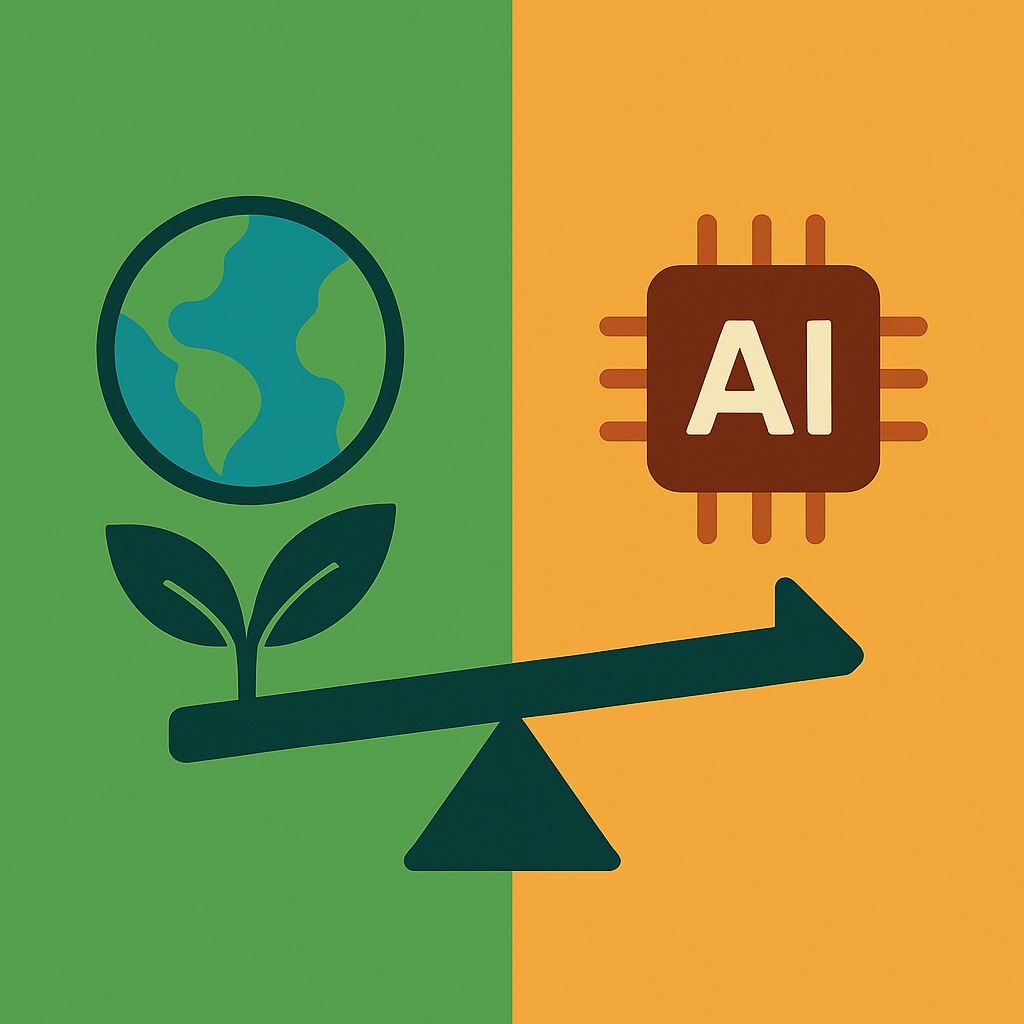
Is AI Eco-Friendly? A Reflection on the Reasoned Use of Artificial Intelligence
AI and Ecology: Sorting Truth from Myth
In the summer of 2025, when we talk about artificial intelligence, misconceptions abound. Some media even warn: “Generating an image with AI pollutes as much as a plane trip.” But beware of misleading shortcuts! The reality is more nuanced: it’s not your daily use of ChatGPT or Midjourney that weighs heavily on the environment, but the initial training of large AI models and their industrial-scale operation.
For example, training a gigantic model like GPT-3 required about 1,287 MWh, generating 552 tons of CO₂ according to an MIT study. That’s equivalent to the carbon footprint of dozens of international flights. But once the model is trained, each interaction with ChatGPT consumes only a few watt-hours, almost negligible at an individual scale.
Between Frivolity and Fear of AI: Finding the Balance
Yet clichés persist. On one side, some people use AI with total carelessness, like a simple Snapchat filter: they generate thousands of images on Midjourney just for fun, ignoring that such use isn’t entirely free ecologically. According to La Repubblica, generating 1,000 images with an AI represents between 100 and 500 grams of CO₂, which remains modest but real (for comparison, a plane trip generates about 285 grams of CO₂ per kilometer per passenger).
On the other side, some Millennials see AI as the source of every current problem: job destruction, informational bias, environmental dangers. But again, scale matters: even using ChatGPT ten times a day, your annual footprint would be about 11 kg of CO₂, only 0.16% of the average annual carbon footprint of a European, according to Sustainability by Numbers. It’s not nothing, but it’s not the environmental monster sometimes imagined.
A Matter of Scale: The Hidden Costs of Large Models
Confusion often stems from clumsy comparisons between very different uses. Large multitask models like ChatGPT or Mistral are indeed real energy factories: they consume up to 30 times more energy than lighter models optimized for a single task, according to Économie Québec. For example, a ChatGPT query requires five times more energy than a simple Google search.

And don’t forget indirect costs. According to MIT, each kilowatt-hour consumed by these large servers requires about 2 liters of water for cooling. In other words, it’s the gigantic infrastructure behind these AIs that poses a real ecological challenge, far more than the moderate everyday use by individuals.
In short, rather than banning or naively using AI, let’s learn to understand it, moderate it, and favor less resource-hungry models—or even local AIs, running directly on our devices. Because artificial intelligence, when designed intelligently, can become a sustainable ally rather than an ecological threat.
Toward Greener AI: Concrete Solutions
To avoid throwing the baby out with the bathwater, we can imagine more frugal AIs. For example, in a 2025 project I suggested a video game where a basic AI would run entirely on the player’s computer, with no external server. The carbon footprint would then be that of a classic game, and the AI would enrich gameplay rather than fill the cloud. Yet my survey showed skepticism—proof that we lack technological literacy.
Still, AI can be an ally against climate change. Inria points out that it helps improve weather forecasts and optimize solar or wind production by better guiding land-use planning. AI isn’t the enemy: it’s a tool. Between naive use (everything for fun) and systematic demonization, ignorance is what harms us. Should we ban AIs like some want to ban vaccines, or learn to use them intelligently?
Sources: media analyses and recent technical studies
Discover my eco-friendly AI video game project here, and why it became my business proposal in 2025.